
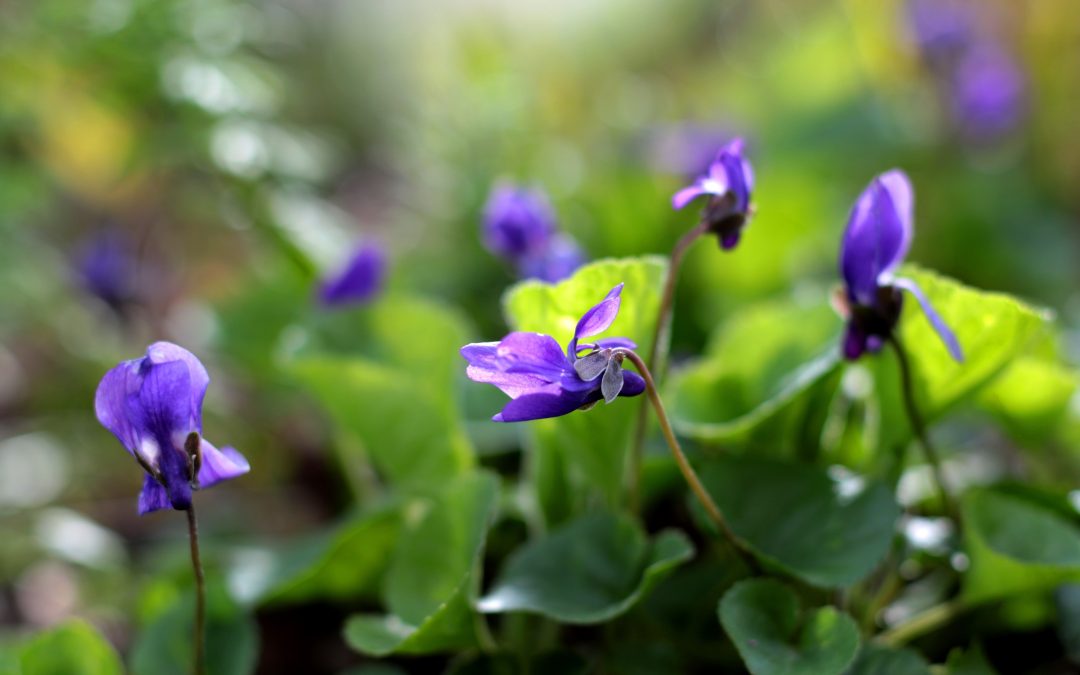
Viola odorata | Family: Violaceae
Cultivation
Sweet Violet can be propagated by separating new stolons from the mother plant or by taking cuttings from runners. It prefers a sunny, open position during winter, with some shade in summer, and grows well beneath deciduous trees. Slightly acidic soil is best. Violet is frost-resistant but drought tender. Removing stolons encourages more flowers.
Look closely at Violet and you’ll discover some fascinating ways it reproduces and spreads. In autumn, pollinated flowers develop seedpods that burst open, scattering seeds some distance from the parent plant. Each seed has a small, nutrient- and sugar-rich appendage called an elaiosome, which attracts ants. Ants carry the seeds away, either eating the elaiosome or taking the seeds to their underground waste piles, where they may later germinate. In this way, Violet gradually expands its patch.
There is another surprise beneath the soil. Dig just below a Violet plant and you may find small, colourless underground flowers. Some Violet species also produce rhizomes, allowing them to spread vegetatively and establish new plants.
Parts Used
The leaves and flowers are used. Leaves can be harvested throughout the season or just prior to flowering. The tender spring leaves are best for eating, while later leaves can be dried for teas and other preparations. Always use the fresh flowers where possible, as dried flowers are bereft of most of their healing properties, which reside in the fresh essential oil. Violet leaves and flowers are very sensitive after drying and degrade quickly. Store dried material in a tightly sealed container in a cool, dark location. The roots are used with caution, as they are toxic in large amounts.
Energy and Flavour
Sweet, salty, cool, mildly bitter and moist
Organ Meridians affected:
Lungs, stomach and liver
Active Constituents
Saponins, methyl salicylate, alkaloids including violine and odoratine, essential oil, flavonoids, glycoside (iridin), anthocyan (violamin) and mucilage.
Nutritional Value
Violet contains vitamins A and C. Both the leaves and flowers can be used in salads and other recipes. Violet is high in antioxidant anthocyanins and rutin, which is known to support heart health by strengthening and increasing the flexibility of blood vessels, reducing cholesterol, and preventing and dissolving blood clots.
Key Actions
Inflammatory modulator, demulcent secretolytic stimulant expectorant, bronchial antiseptic, antimicrobial, antiviral, antitussive (relieves coughing), anti-neoplastic, anti-tumour, diuretic, mild laxative, anti-rheumatic, alterative, antiseptic, antioxidant, antipyretic, vulnerary, antispasmodic, lymphagogue and mild sedative.Especially for cancers of the breast, lungs and gastrointestinal organs.
Flower Essence
Sweet violet flower essence is energetically linked to the crown chakra, resonating with shades of violet, purple or white to support spiritual connection, higher consciousness, and gentle emotional release. It’s the essence of the heart associated with the Divine Mother energies of peace, serenity, and expansion. Soothe emotional grief, soften rigid emotional guards and assist with overcoming shyness.
The Doctrine of Signatures provided with the Sweet Violet flower essence are shown in its heart shaped leaves as well as within the flower itself. The violet colour of the flower reflects the colour found within your crown chakra as well as being the colour of the violet flame. This flame is a beautiful etheric tool offered by the Master St. Germaine for humanity to use to purify, cleanse, transmute into light, release and to protect against negative energies and thought forms. This flower essence offers within it these properties as the violet light is taken through the body’s energy centres.
Medicinal Value
Violet is a plant of Venus, of a mild nature, associated with modesty and simplicity. It is a symbol of both the beauty and transitory quality of life, and has been associated with death, particularly the death of the young. In Greek rituals, the dead were covered with violet flowers.
Historically, Violet has been used to moderate anger, comfort and strengthen the heart, and for headaches associated with insomnia and tiredness. It has also been traditionally used for conditions of the head, gout, epilepsy, tumours, pleurisy, jaundice, quinsy, kidney and bladder problems, and conditions of the female reproductive tract.
In observing the signature of the plant its nodules creeping like beads and its runner patches resembling major lymphatic collections we learned of its benefits to the lymphatic system, assisting in the clearing of lymphatic blockages and restoring healthy lymphatic flow. Violet has a special affinity for the breasts, including fibrocystic breasts, mastitis, lumps, infections, growths and breast cancer.
Colds, Influenza, Dry Coughs and Sore Throats
Violet softens and soothes dry, inflamed tissues, making it particularly suited to bronchitis, dry coughs, irritated airways and sore, dry throats. Traditionally used as a tea, syrup or infused honey, it can provide soothing relief. Violet-infused oil rubbed on the abdomen may assist with fever management.
Congested Lymph | Lymphatic Detoxifier
Violet has long been valued for moving stagnant lymph and softening hardened or congested glandular tissues. As a tea or fresh tincture, it may be used traditionally for hot, swollen lymph nodes associated with upper respiratory infections. Taken internally or applied externally as a poultice or infused oil, Violet can gently support congested lymphatic glands, including those of the breasts, armpits and groin.
Violet has also been investigated in relation to cancer. While there are no clinical trials confirming benefits in people with cancer, in-vitro research has identified constituents of Viola odorata with cytotoxic activity that may have potential as chemosensitising agents against drug-resistant breast cancer.
Digestion
The mucilaginous component of violet leaf tea soothes gut mucosal inflammation, and as mucilage is a soluble fibre it has a role in reducing cholesterol levels. Soluble fibres are also prebiotic and help to restore healthy populations of beneficial bacteria in the gut.
Blood Vessel Walls
The active flavonoid ingredients of native violet leaves, quercetin and particularly rutin, are traditional remedies to strengthen blood vessel walls, so have been prescribed to reduce haemorrhoids and varicose veins
Antimicrobial and Antiviral
Cyclotides, an active ingredient in violet leaves, with their sulphur-rich protein structures have strong antibacterial activity against Gram-negative bacterial activity such as E. coli and Staphylococcus aureus.Research has shown that the cyclotide in V. hederacea cycloviolacin H4 also has measurable anti-HIV activity.
Inflammation and Pain
Where inflammation is associated with heat and dryness, Violet’s cooling, moistening and soothing qualities make it a traditional herbal choice.
Sleep
Although not widely used for sleep in Western herbalism, Violet has a traditional history as a remedy for sleep in Iran.
Dry Eyes, Sinuses and Skin
Violet’s moistening and soothing qualities make it traditionally useful for dry or irritated eyes, sinuses and skin. For dry sinuses and eyes, herbalist Jim McDonald recommends an eye or nasal wash: “A mild tea of fresh or dried violet leaves can be made into a nasal rinse by adding 1/4 teaspoon of salt per 8-ounce cup of well-strained tea, and it is wonderfully soothing when dryness accompanies inflammation of the sinuses. This same preparation can be used as an eyewash and is quite impressive; use it when the eyes are dry and blinking feels like someone’s scratching sandpaper over your cornea.
Its benefits extend to the skin, where Violet may help soothe dryness and itching while also supporting lymphatic circulation. It can be taken internally or applied externally. In one study, Violet-infused oil was more effective than massage alone for severe itching associated with chronic kidney failure (uraemic pruritus). Another study found that a preparation containing Mahonia aquifolium (Oregon grape), Viola tricolor and Centella asiatica (gotu kola) relieved moderate atopic dermatitis during cold, dry weather.
Violet Leaves
Violet leaves are a standard adjunct remedy to tumours and a cancer care ally. This reputation goes back to the early centuries and has remained to the present day. Early literature, particularly from India and Egypt, documents the plant’s ability to dissolve abnormal growths. Fresh Violet leaves are preferred for these purposes, both internally and externally.
Violet is nourishing, soothing and cooling to the liver, gallbladder, digestive, urinary and nervous systems. It has an affinity for the head, mind, brain and crown chakra, benefiting migraines, traumatic remembering and feverish fears, and helping those troubled with nightmares, insomnia and distressed sleep.
The salicylate in the plant provides anti-inflammatory actions for musculoskeletal disorders and rheumatism. Violet may also be used as a mouthwash for ulceration and swelling of the mouth and throat. Externally the leaf can be made into a poultice for wounds, pimples, abscesses, sores, swelling, chronic and persistent skin diseases, herpes, sore breasts, red and sore eyes, and mastitis.
Violet Flowers
Violet flowers are edible and delicately sweet. They are used to garnish food, in salads and in cooking, especially in French cuisine.
Violet syrup is made with the fresh flowers. It is a pleasant remedy, especially for children, and helps to relieve an inflamed throat and dry cough. It has also traditionally been used for digestive complaints such as stomach-ache and constipation, as well as respiratory bronchitis, chronic nasopharyngeal catarrh and pulmonary congestion.
Violet flower-infused oil may relieve tinnitus but should not be used if the eardrum is perforated.
Fresh Root
The root can be crushed and infused in vinegar for several hours, then applied as a poultice to sore or injured feet and chronic foot problems experienced with diabetes.
Specific
Congestive pulmonary conditions; tumours, especially of the breast and alimentary canal; and traditionally believed to protect against metastases.
Plant Preparations
Food, tea, tincture, vinegar, syrup, liqueurs, candied Violet flowers, infused oil, salve, cream and poultice.
Dose Three times daily:
Dried herb: 2–4 g | Tincture: 2–5 mL | Liquid extract (1:1): 2–4 mL
Violet tea aerial parts, steep fresh or dried herb in three cups of boiling water, consume a cupful three times daily.
Steamed leaves make a delicious potherb.
Contraindications:
None noted
Special Considerations
- Violet roots can be emetic (make you vomit).
- Violet species that are high in saponins may cause nausea if too much is eaten.
- Some Violet species may cause diarrhea if too much is eaten, probably due to their saponin content.
What the research tells us
- Rich in plant compounds: Sweet violet contains flavonoids, phenolic compounds, saponins, glycosides, terpenoids, alkaloids and mucilage.
- Different parts offer different constituents: Leaves, flowers, roots and seeds contain varying compounds, including salicylic acid, stigmasterol, anthocyanins and rutosides.
- Mucilage-rich: The leaves and flowers have traditionally been valued for their soothing, softening qualities.
- Antioxidant activity: Research has demonstrated antioxidant activity in extracts from different parts of the plant.
- Traditional respiratory use: Flowers and leaves have a long history of use in traditional herbal medicine for coughs and respiratory complaints.
- Cyclotides: Sweet violet is particularly notable for its cyclotides, natural plant compounds being investigated for antibacterial, antifungal, insecticidal and other biological activities.
- Essential oils: Violet flowers and leaves contain a range of aromatic compounds and have been used in perfumery and aromatherapy.
- Edible flowers: Sweet violet flowers are edible and contain nutrients, minerals and antioxidant compounds.
For those who would like to explore the research in greater depth:
Read the full research article on Sweet Violet (Viola odorata) https://www.mdpi.com/2223-7747/15/18/2747