
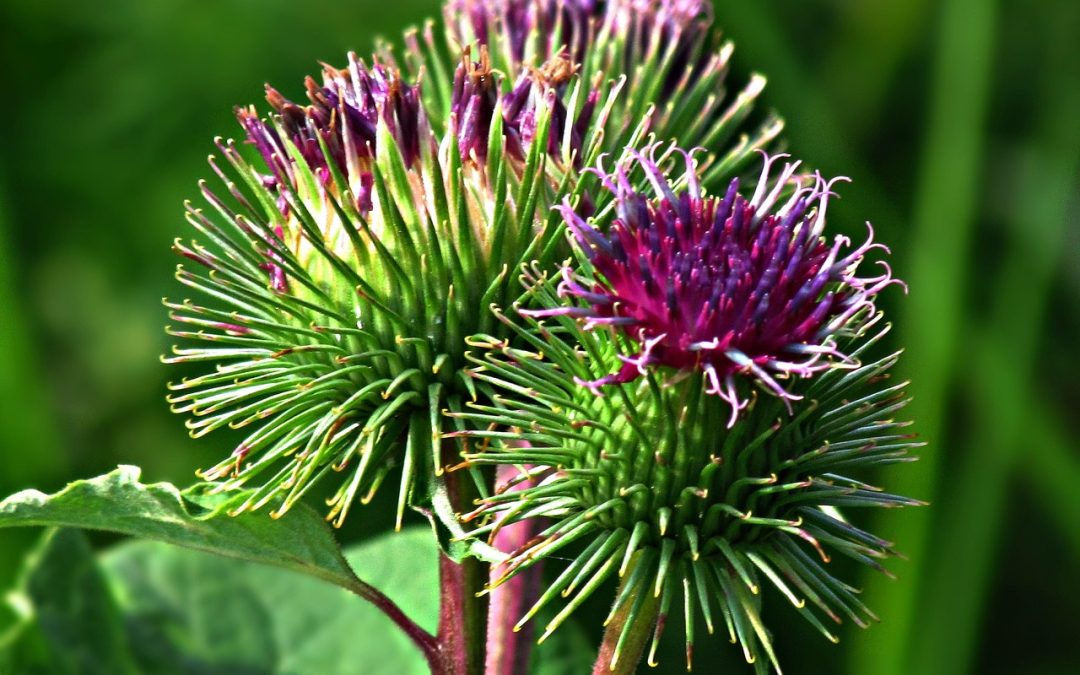
Burdock Root |Arctium lappa | Family Asteraceae.
Deep cleanser | Blood purifier | Liver & Skin ally
Autumn is root time, and for many herbalists, burdock is the favourite root. It is the archetypal alterative a deep-cleansing herb that supports elimination, liver function, lymphatic flow and skin health. In traditional herbalism, burdock has long been valued for its ability to “clear the blood,” strengthen digestion, and restore balance to chronic, inflamed conditions.
Botany & Description
Burdock is a hardy biennial plant in the Asteraceae family, native to Northern Europe and Siberia and now naturalised worldwide. It grows about 1–1.5 metres tall, with large heart-shaped leaves that are deep green on top and pale underneath. In summer it produces purple-red tubular flowers that develop into the familiar burrs that cling to clothing and fur.
The medicinal and culinary treasure lies underground:
a long, slender taproot reaching 60–90 cm in length, brown on the outside and creamy-white within, similar in shape to carrot or parsnip. Only Greater burdock (Arctium lappa) and Lesser burdock (A. minus) are commonly used medicinally.
Traditional & Cultural Use
In Japan, burdock is known as gobo and has been cultivated as both food and medicine for centuries. It is widely eaten in soups, stir-fries, and kinpira dishes, and traditionally used to support digestion, blood sugar balance, blood pressure, and detoxification.
In Western herbalism, burdock has long been used for:
- Skin conditions
- Liver and gallbladder stagnation
- Blood cleansing
- Rheumatic and inflammatory states
It was also one of the key herbs in the famous early 20th-century Essiac cancer formula.
Energetics & Herbal Actions
Burdock is:
- Cooling
- Moistening
- Sweet and slightly salty
- Grounding
Herbal actions:
- Alterative (blood cleanser)
- Liver and lymphatic tonic
- Diuretic
- Anti-inflammatory
- Prebiotic digestive support
It is especially suited to hot, inflamed, dry, or toxic conditions particularly those that show on the skin.
Constituents & Modern Research
Burdock root is rich in:
- Inulin-type fructans (prebiotic fibres)
- Pectic polysaccharides (rhamnogalacturonans)
- Lignans and polyphenols
- Minerals including potassium, magnesium, iron, manganese
- Vitamins C, E, B-complex
These water-soluble polysaccharides are best extracted through decoction (hot water extraction) one reason burdock root tea is so effective.
Modern research confirms that burdock polysaccharides have:
- Anti-inflammatory
- Antioxidant
- Blood-sugar-lowering
- Cholesterol-lowering
- Immune-modulating
- Gut-flora-supporting actions
Food as Medicine: Nutritional Value
Burdock root is:
- Low in calories (about 72 kcal per 100 g)
- Rich in fibre and inulin
- High in potassium, supporting blood pressure and heart health
- A gentle laxative and detoxifier
- Supportive for blood sugar balance
The inulin feeds beneficial gut bacteria, improving digestion, immunity and metabolic health.
Skin, Liver & Blood
Burdock is one of the great skin herbs. Herbalists across traditions use it for:
- Eczema
- Psoriasis
- Acne
- Boils
- Dry, scaly, irritated skin
Michael Moore described burdock as a powerful alterative for “cold liver types,” and David Hoffman called it the most valuable remedy for chronic dry skin disorders, especially psoriasis when used long-term.
Because the skin is a mirror of the liver and lymph, burdock works from the inside out—clearing waste, cooling inflammation, and restoring tone.
Inflammation & Arthritis
Burdock has long been used for arthritis, gout and rheumatism.
Modern studies support this: people with knee osteoarthritis who drank three cups of burdock root tea daily for 42 daysshowed improved inflammation and reduced oxidative stress.
Preparation & Use
Decoction | Tinctures | Liquid Extracts
Decoction the best method for polysaccharides. Simmer 1–2 teaspoons dried root (or 1–2 tablespoons fresh) in 500 mL water for 20–30 minutes. Drink 1–3 cups daily.
Food
Burdock can be eaten like a vegetable—boiled, stir-fried, roasted, or added to soups.
To prepare:
- Scrub and peel the root
- Slice thinly
- Soak briefly in lemon water to prevent browning
- Cook until tender
Safety
Burdock is very safe for most people.
Avoid if:
- You have allergies to Asteraceae (daisy family)
- You are taking potassium-sparing diuretics
Synergistic Herbs / Combines Well With
Combines well with:
- Dandelion root – supports liver and detoxification
- Yellow dock – enhances skin and elimination benefits
- Nettle – adds minerals and anti-inflammatory support
- Cleavers – promotes lymphatic cleansing
- Red clover – nourishes blood and supports skin
In Essence
Burdock is a deep, slow, steady healer restoring the liver, clearing the blood, feeding the gut, and soothing chronic inflammation. It is one of the finest herbs for long-term vitality, resilient skin, and clean, well-functioning internal terrain.
Cultivation
Burdock grows best in full sun to part shade, with at least 3 hours of direct sun daily.
Roots can grow 1 m or more, so choose deep, loose, well-drained soil rich in organic matter. Prepare soil by removing weeds, digging deeply, and adding compost or aged manure. Organic matter also helps lighten heavy soils. Keep the area weed-free before planting.
Burdock readily self-seeds. Plant where volunteers are welcome, deadhead before seed set, or grow in containers if you want to limit spread.
How to Sow Burdock Seeds
Optional: Soak seeds before sowing to improve germination.
- Sow directly into the garden is best (burdock dislikes root disturbance).
- Plant seeds 15 mm deep, 15 cm apart, with 60 cm between rows.
- Keep soil moist, not wet or dry.
- Germination occurs in 7–14 days at 20–25°C.
- Protect young seedlings from pests, pets, and harsh weather.
If starting in trays (autumn only), use deep biodegradable pots to minimise root shock
How to Grow Burdock
Water when soil is dry 5 cm below the surface. Water deeply in the early morning or late afternoon, avoiding wet leaves to prevent fungal issues.
Thin seedlings if needed so plants are spaced 15 cm apart.
Burdock grows well in poor soils and does not require fertiliser.
How to Harvest Burdock
Harvest in about 120 days.
Roots are best picked when 50–60 cm long and still tender.
Lift roots carefully with a garden fork (do not pull by leaves). Shake off soil and cut foliage 1–2 cm above the root. Store short-term in the fridge in a perforated plastic bag.
Common Problems
- Aphids: Hose off, use soap/alcohol spray, or encourage beneficial insects.
- Forked roots: Caused by heavy or stony soil—improve soil structure or grow suited varieties.
- Small roots: Result from overcrowding or excess fertiliser—thin seedlings and avoid feeding.
- Split roots: Due to irregular watering—water deeply and consistently.
- Tough roots: Harvested too late—pick young for best texture.
Burdock | Arctium lappa
Cultivation
Burdock grows best in full sun to part shade, with at least 3 hours of direct sun daily.
Roots can grow 1 m or more, so choose deep, loose, well-drained soil rich in organic matter. Prepare soil by removing weeds, digging deeply, and adding compost or aged manure. Organic matter also helps lighten heavy soils. Keep the area weed-free before planting.
Burdock readily self-seeds. Plant where volunteers are welcome, deadhead before seed set, or grow in containers if you want to limit spread.
How to Sow Burdock Seeds
Optional: Soak seeds before sowing to improve germination.
- Sow directly into the garden is best (burdock dislikes root disturbance).
- Plant seeds 15 mm deep, 15 cm apart, with 60 cm between rows.
- Keep soil moist, not wet or dry.
- Germination occurs in 7–14 days at 20–25°C.
- Protect young seedlings from pests, pets, and harsh weather.
If starting in trays (autumn only), use deep biodegradable pots to minimise root shock
How to Grow Burdock
Water when soil is dry 5 cm below the surface. Water deeply in the early morning or late afternoon, avoiding wet leaves to prevent fungal issues.
Thin seedlings if needed so plants are spaced 15 cm apart.
Burdock grows well in poor soils and does not require fertiliser.
How to Harvest Burdock
Harvest in about 120 days.
Roots are best picked when 50–60 cm long and still tender.
Lift roots carefully with a garden fork (do not pull by leaves). Shake off soil and cut foliage 1–2 cm above the root. Store short-term in the fridge in a perforated plastic bag.
Common Problems
- Aphids: Hose off, use soap/alcohol spray, or encourage beneficial insects.
- Forked roots: Caused by heavy or stony soil—improve soil structure or grow suited varieties.
- Small roots: Result from overcrowding or excess fertiliser—thin seedlings and avoid feeding.
- Split roots: Due to irregular watering—water deeply and consistently.
- Tough roots: Harvested too late—pick young for best texture.
The information provided is for educational purposes and is not intended to be a substitute for medical treatment. Consult your medical care provider before using herbal medicine, particularly if you have a known medical condition, are on any medication, and if you are pregnant or nursing.